Two sections, two rulebooks. Check the plot's rules before you pay for the stone
A Fisherman's Rest- Subject
- Choosing, commissioning, and paying for cemetery monuments and grave markers
- Editor
- The A Fisherman's Rest team
- Subject
- Choosing, commissioning, and paying for cemetery monuments and grave markers
Rules travel with the section
Cemetery regulations are frequently written per section rather than for the whole property. The plot you choose determines which schedule of heights, materials, and base sizes applies to you.
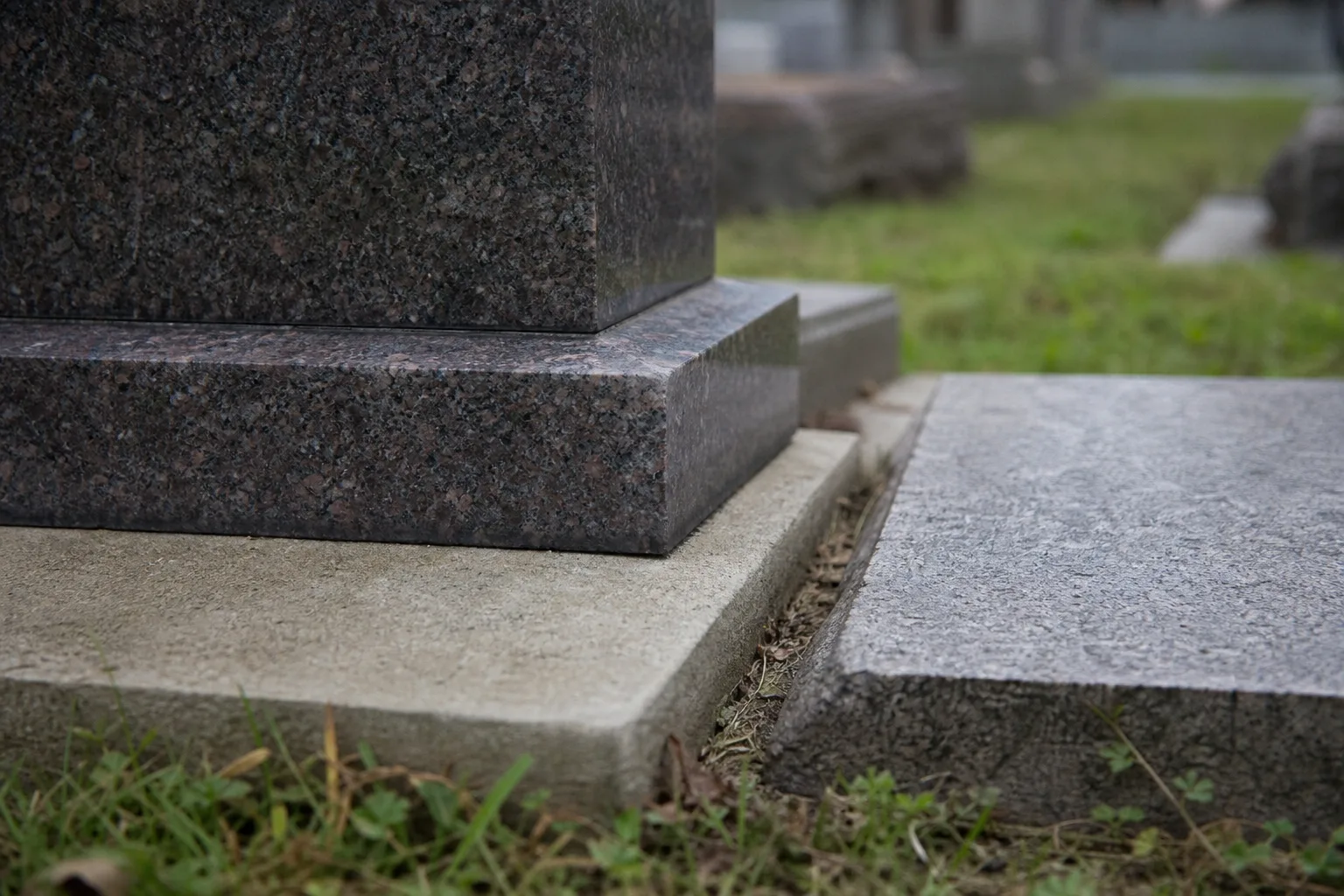
Most cemeteries tie the maximum base dimension to the width of the interment right you own. A double plot generally allows a wider companion base than two single graves bought separately.
The deed to a grave says almost nothing about what may stand on it. That information lives in a separate document, the cemetery's rules and regulations, and in most places it does not apply uniformly across the grounds. A single cemetery can operate a flush-marker lawn section, an older monument section platted eighty years ago, a cremation garden with its own dimensional limits, and a veterans or fraternal section with rules borrowed from a third party. Buy the plot first and choose the stone second, and you may find the two do not agree.
Why one cemetery ends up with several rulebooks
Sections get their rules from the era in which they were platted and from how the grounds crew intends to mow them. Older ground, laid out when families expected uprights, usually permits them still, sometimes with generous height allowances that no longer exist anywhere else on the property. Newer ground is frequently sold as a memorial park, where every marker sits flush with the turf so a gang mower can pass over it. Cremation gardens, columbarium surrounds, and infant sections each tend to carry their own dimensional schedules. None of this is arbitrary, but none of it is obvious from the driveway either.
The four limits that decide what you can order
Four numbers govern most of it. Maximum height above the foundation, which separates an upright from a slant from a flush marker. Maximum base length and width, usually keyed to the width of the grave or the double plot, and often expressed as a base no wider than the interment right you actually own. Permitted materials, which in practice means granite and bronze, sometimes with a color restriction or a ban on marble in newer ground. And foundation specification, meaning who pours it, how deep, and what it costs per square foot or per inch of base. Get those four in writing and a monument dealer can price the job accurately on the first pass.
What a careful reader checks before signing
Ask for the written regulations that apply to the specific section and block you are buying, not the general brochure, and look for a revision date on the document. Ask whether the rules in force are the ones printed today or the ones in effect when the section was sold, because grandfathering is common and rarely volunteered. Ask what happens to a marker installed under old rules if the family later wants it replaced. Then ask the direct question: if you buy this plot, will an upright monument of the size you have in mind be approved, and who signs that approval. The Federal Trade Commission oversees how funeral goods and services are sold and disclosed, and the same instinct applies here. Everything material should be on paper.
Comparing two sections on money, not just appearance
The plot price is only one line. A section that allows uprights normally requires a poured foundation, charged by the cemetery, and that charge can be a meaningful fraction of the stone itself. A flush-marker section may require a granite or concrete base under the bronze, or a setting fee, or both. Some cemeteries add a perpetual care contribution tied to marker size, and some collect an inspection or permit fee before the setter is allowed through the gate. Ask each section's total, plot plus foundation plus setting plus any care fund, and compare those figures rather than the per-grave price on the price list.
Walk both sections before you commit
Twenty minutes on foot settles questions that a phone call will not. Look at what is actually standing in the section you are considering, measure a base or two against the grave width, and note whether the uprights are consistent in scale or whether a few older, larger stones sit among smaller recent ones, which usually signals a rule change. Check drainage and the grade, because a section that holds water will settle foundations unevenly over decades. Look at how close the mowing line runs to the stones. Then compare that with the section you are being steered toward.
The plot and the monument are one purchase made in two transactions, and the first one constrains the second. Reading the section's rules before the deed is signed keeps both decisions in your hands.
The cemetery usually pours the foundation itself and bills for it, often by the square foot or by inches of base length. Ask for that figure before you finalize the monument size.