Ordering a headstone? Nine things to check on the lettering line before you sign
A Fisherman's Rest- Subject
- Choosing, commissioning, and paying for cemetery monuments and grave markers
- Editor
- The A Fisherman's Rest team
- Subject
- Choosing, commissioning, and paying for cemetery monuments and grave markers
Signed proof, not a verbal order
A scaled drawing signed by the purchaser is the document a dealer will fabricate from. Nothing agreed on the phone survives a dispute if the proof says otherwise.
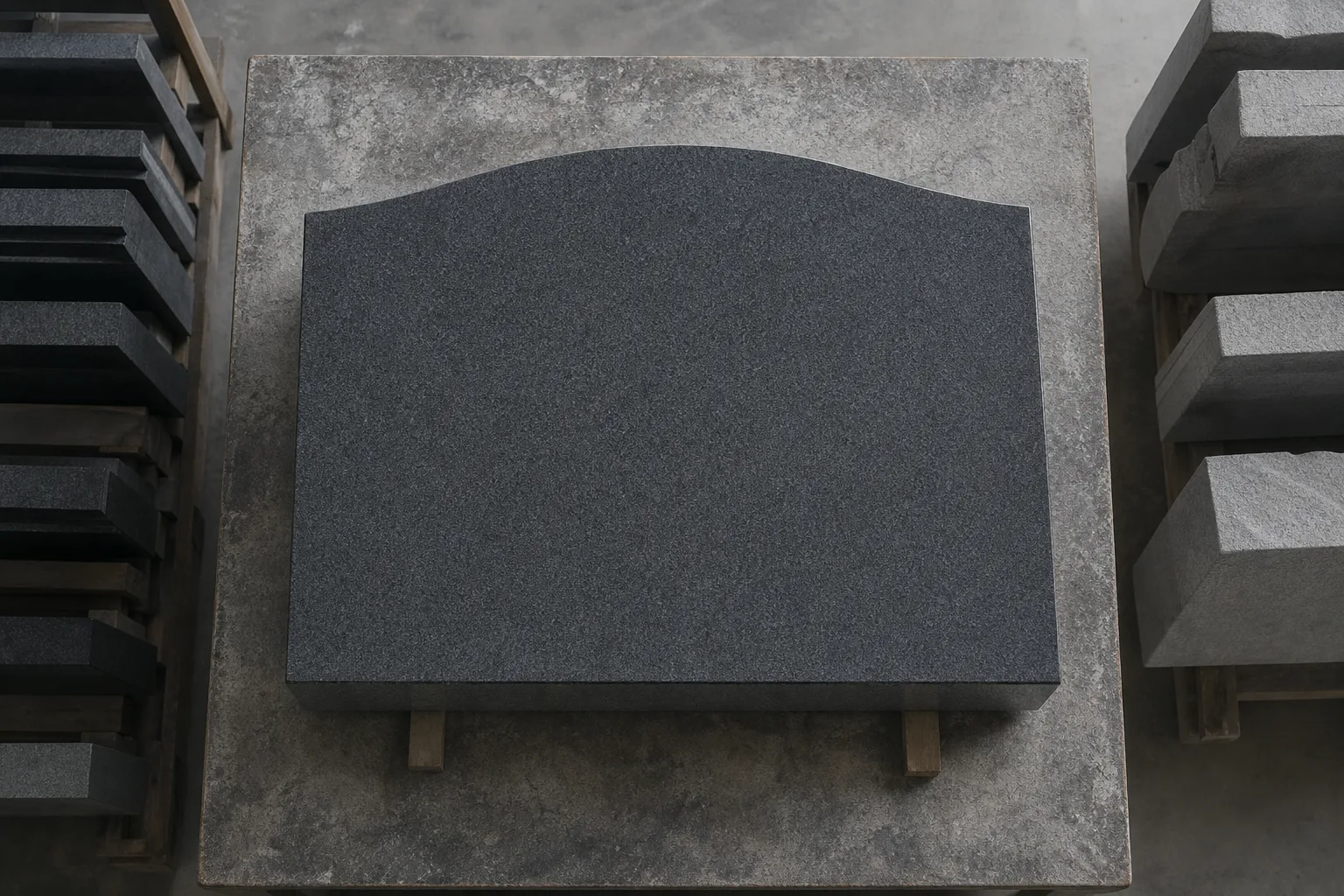
These are the fields families most often get wrong, because everyday usage has drifted from the legal spelling. Check them against a birth certificate or marriage license.
Most of what goes wrong with a monument order goes wrong on one line of the contract: the lettering. Stone is forgiving about almost nothing, and a misspelled middle name, a date transposed from a funeral program rather than a death certificate, or a font too shallow to read at forty years does not get fixed cheaply. Dealers will tell you the same thing if you ask them directly. The granite is the easy part. The inscription is where the money, the errors, and the regret concentrate, and where a careful reader slows down before signing.
The proof, and who is responsible for it
First, ask for a scaled drawing, not a description, and confirm in writing that no work begins until you have signed it. A proof shows the actual layout: name placement, line breaks, the relationship of the letters to the edges of the die. Second, check every proper noun against a source document rather than memory. Use the death certificate for dates, and the birth certificate or a marriage license for the spelling of a maiden name that family has been shortening for sixty years. Third, read the contract clause that assigns liability for errors, because almost every dealer places it on the signer of the proof.
What the letters cost, and how they are counted
Fourth, find out whether lettering is included in the quoted price or billed by the character, and if by the character, whether spaces, dashes, and punctuation count. A verse of scripture that reads beautifully on paper can add a meaningful sum when it is priced at so much per letter. Fifth, ask what a later inscription will cost, and get the figure now. Adding a second death date years on typically carries a minimum charge, a travel or setup fee for cemetery work, and a per-character rate that will have moved. That number belongs in your file, not in a future phone call.
How the letters are cut, and how long they will read
Sixth, confirm the cutting method and the depth. Sandblasted lettering through a rubber stencil is the standard for modern granite and holds up well; hand-cut or V-sunk work costs more and reads differently in raking light. Depth matters more than font choice for legibility over decades, particularly on lighter granites where contrast fades. Seventh, ask whether the letters will be painted or lithichromed, and treat that as maintenance rather than permanence. Paint in a recessed letter lasts years, not generations, and refreshing it is a small, recurring, entirely optional expense you should know about before it surprises a grandchild.
Layout, and the space you are leaving for later
Eighth, look hard at what the drawing leaves empty. On a companion monument, the surname is usually centered and the two given names sit below, which means the second inscription is constrained by decisions made today. Check that the birth date and a blank space for the death date are balanced, that the second name has the same letter height as the first, and that a middle initial you may want later will still fit. Ask the dealer to mark the reserved area on the proof. A visible blank panel is easier to protect than an assumption.
Cemetery rules and the setting
Ninth, get the cemetery's written approval before fabrication, not after. Many grounds restrict lettering height, prohibit certain emblems or photographic ceramics, and require a permit and a foundation order with its own fee and lead time. The Federal Trade Commission oversees consumer disclosure in funeral goods and services, and the practical version of that principle here is simple: ask for every charge in writing, including foundation, delivery, and setting, and ask when the stone is expected to arrive. Six to twelve weeks is common; a cemetery that closes for winter setting can extend it.
Take the proof home. Read the names aloud to someone who was not in the room when the order was placed, check the dates against the certificate one more time, and sleep on the wording of any epitaph you drafted in the first raw week. A monument dealer would rather hold the job three days than recut a die, and the family that reads it in thirty years will never know the difference except that everything on it is right.
Many shops include a set number of characters and bill beyond it by the letter. Ask whether spaces and punctuation are counted before you approve a long epitaph.